Deprecated: mb_convert_encoding(): Handling HTML entities via mbstring is deprecated; use htmlspecialchars, htmlentities, or mb_encode_numericentity/mb_decode_numericentity instead in /home/cardenitservices/public_html/wp-content/themes/hello-elementor-child/functions.php on line 128
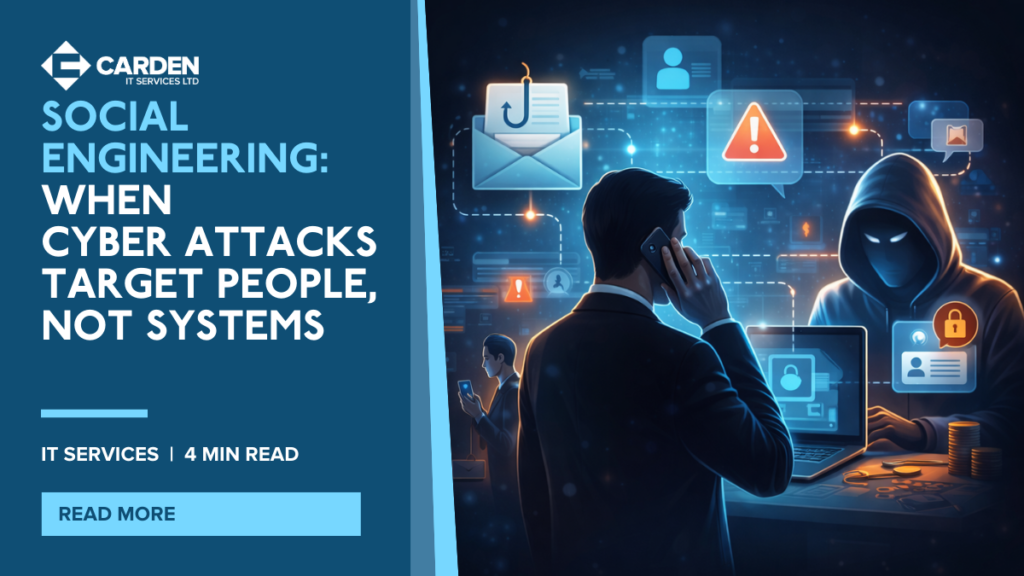
Would your employees recognise a cyber attack if it arrived as a friendly phone call or email?
Many serious data breaches do not begin with advanced malware or complex code. Instead, they start with deception. Social engineering attacks exploit trust, urgency, and human nature, often bypassing even the strongest technical security controls.
What Is Social Engineering?
Social engineering is a type of cyber attack that relies on deception rather than technical hacking. The attacker manipulates people into giving away sensitive information or granting access to systems they should not.
This might involve impersonating a senior employee, a trusted supplier, or an internal IT contact. Once trust is established, the attacker applies pressure to encourage quick decisions without proper verification.
Why Social Engineering Is So Effective
Even organisations with strong cybersecurity controls remain vulnerable to social engineering because people are involved. Attackers understand how businesses operate and use realistic scenarios to exploit that knowledge.
These attacks often succeed because:
- Requests appear urgent or authoritative
- Employees want to be helpful and responsive
- Communication happens remotely rather than face to face
- Attackers already know names, roles, and internal details
Who Is Most at Risk?
Social engineering can affect any organisation, but the risk increases as businesses grow. In larger teams, employees are less likely to personally know everyone they interact with, making impersonation easier.
Remote and hybrid working environments also increase risk, as more communication now happens by phone, email, and messaging platforms instead of in person.
Common Social Engineering Techniques
| Technique | How It Works | Risk to Your Business |
|---|---|---|
| Impersonation | Pretending to be a senior employee or trusted contact | Account compromise and data exposure |
| Phishing Emails | Messages designed to trick users into clicking links or sharing data | Credential theft and malware infection |
| Vishing | Phone calls that pressure employees into revealing information | Unauthorised system access |
| Pretexting | Creating believable stories to justify suspicious requests | Loss of sensitive or financial data |
How Social Engineering Bypasses Technical Security
Firewalls, antivirus software, and email filtering are essential, but they cannot stop an employee from willingly handing over information if they believe the request is legitimate.
Once attackers gain access through social engineering, they can move laterally across systems, impersonate internal users, and escalate the attack with alarming speed.
How Carden IT Services Helps Reduce Social Engineering Risk
At Carden IT Services, protecting against social engineering is a key part of our managed cyber-defence approach.
We support businesses through:
- Cybersecurity awareness training to help employees recognise suspicious requests and feel confident saying no
- Real-world penetration testing that includes social engineering techniques
- Clear reporting and follow-up guidance to strengthen policies and processes
By educating staff and testing defences in realistic scenarios, businesses can significantly reduce the likelihood of a successful social engineering attack.
Security Starts With Awareness
Social engineering attacks succeed when people are unsure, rushed, or unprepared. Awareness, confidence, and clear procedures are just as important as technical security controls.
If you want to reduce the risk of human-led cyber attacks and strengthen your overall security posture, contact Carden IT Services today to discuss cybersecurity awareness training and managed cyber-defence solutions.