
Deprecated: mb_convert_encoding(): Handling HTML entities via mbstring is deprecated; use htmlspecialchars, htmlentities, or mb_encode_numericentity/mb_decode_numericentity instead in /home/cardenitservices/public_html/wp-content/themes/hello-elementor-child/functions.php on line 128
- 1. Response times are slow, vague, or impossible to predict
- 2. Support is purely reactive and the same issues keep coming back
- 3. There is no clear documentation or reporting
- 4. Your provider does not really understand your business
- 5. Your security has not been reviewed in six months or more
- What to Do Next if This Sounds Familiar
Are you starting to wonder whether your IT provider is actually helping your business, or just keeping the lights on?
For many small and medium-sized businesses, IT support only gets questioned when something goes wrong. A server drops offline, email stops working, staff cannot log in, or a cybersecurity issue appears seemingly out of nowhere. But the bigger problem is often what happens in between those moments.
If your provider is slow to respond, fixes the same issues again and again, or never seems to understand how your business actually operates, you may not be getting the value you think you are paying for.
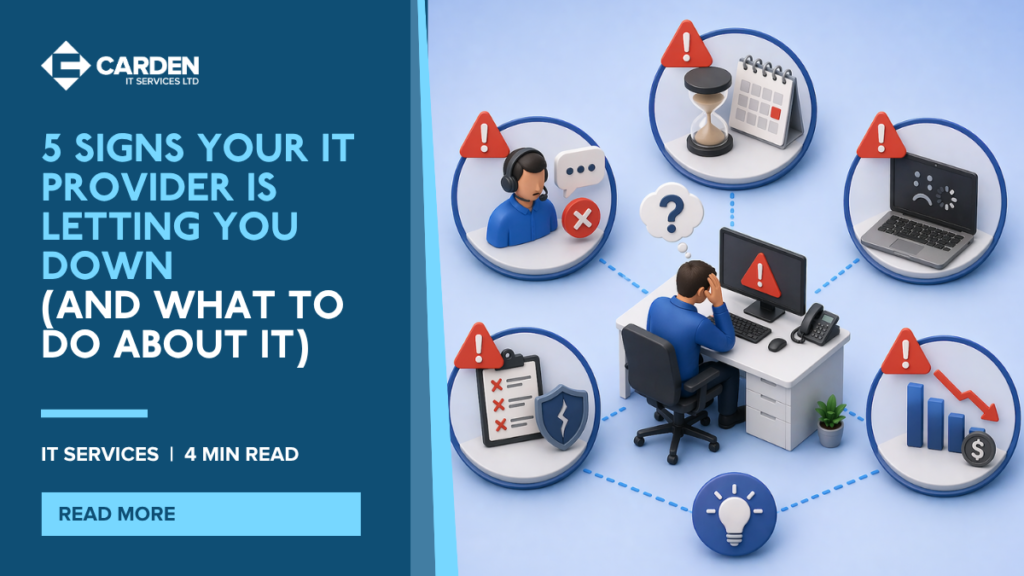
Here are five clear signs your IT provider may be letting you down, along with practical steps you can take next.
1. Response times are slow, vague, or impossible to predict
One of the first warning signs is inconsistent support. You raise a ticket and hear nothing for hours. Sometimes things get sorted quickly, sometimes they do not. You are left chasing updates rather than getting clear answers.
That is not just frustrating. It creates uncertainty for your team and makes even small IT issues feel bigger than they need to be.
A good IT provider should be able to explain exactly what happens when you log a problem. That usually means having a clear SLA, or service level agreement. In plain terms, that is the agreed timeframe for response and, where possible, resolution.
| What to look for | Poor support | Good support |
|---|---|---|
| Response time | No defined timeframe or inconsistent replies | Clear response targets based on issue priority |
| Updates | You have to chase for progress | Regular updates without needing to ask |
| Escalation | No obvious route when an issue drags on | Named escalation path for urgent problems |
| Transparency | Lots of vague wording and no accountability | Clear expectations from the outset |
If your provider cannot tell you what their SLA is, or if they hide behind vague promises like “we will get to it as soon as possible”, that is a red flag.
2. Support is purely reactive and the same issues keep coming back
Good IT support should not feel like a constant game of whack-a-mole. If the same printer issue, Wi-Fi complaint, login problem, or software error keeps returning, your provider may be treating symptoms instead of fixing root causes.
Reactive support has its place. Things break, and you need help quickly when they do. But if your provider only shows up when something has already gone wrong, your business ends up carrying the cost of repeated disruption.
A stronger approach includes prevention as well as repair. That might involve regular maintenance, trend spotting, patching, device reviews, or identifying recurring faults before they turn into downtime.
- Are the same tickets appearing month after month?
- Do users keep reporting issues that were supposedly fixed already?
- Has anyone explained why the problem keeps happening?
If the answer is no, it may be time to ask whether your provider is really improving your environment, or simply maintaining a cycle of repeat issues.
3. There is no clear documentation or reporting
You should not need to rely on memory when it comes to your IT setup. If your provider has never shared documentation, reports, or a basic overview of your environment, that creates risk.
At minimum, there should be some record of what systems you use, how they are managed, what changes have been made, and what risks still exist. Without that, decisions get delayed, handovers become messy, and simple tasks can take longer than they should.
Reporting matters too. A good provider should be able to show what they are doing for you, not just tell you they are “looking after it”.
Useful reporting might include:
- ticket volumes and response performance
- recurring issues or problem trends
- asset and warranty information
- backup status and patching summaries
- security findings and recommended actions
One client came to Carden IT Services after years with a provider who handled issues as they came up, but never supplied clear documentation or regular reporting. When staff changes took place, and a hardware issue affected part of the business, nobody had a clear record of key systems, support history, backup status, or upcoming warranty expiries.
What should have been a straightforward task took far longer than it should have, simply because the information was not documented properly. Once Carden IT Services took over, we built a clearer picture of the environment through a comprehensive network assessment, introduced regular reporting, and gave the client better visibility over risks, assets, and ongoing support activity.
4. Your provider does not really understand your business
IT support should not exist in a vacuum. A provider can be technically capable and still be the wrong fit if they do not understand how your business works day to day.
For example, a recruitment firm, a construction business, and a professional services company all rely on technology differently. The systems they use, the busy times they face, and the impact of downtime will vary.
If your IT provider does not ask questions about your workflows, growth plans, compliance needs, or commercial priorities, they may be supporting your systems without supporting your business.
You should expect your provider to understand things like:
- which systems are business-critical
- when downtime would cause the most damage
- how your teams actually use technology
- where future growth or change may create pressure
When that understanding is missing, support becomes generic. You get one-size-fits-all advice, and that rarely leads to the best outcome.
5. Your security has not been reviewed in six months or more
This is one of the biggest warning signs of all. If nobody has reviewed your security position in the last six months, there is a good chance gaps have opened up without anyone noticing.
Cybersecurity risks do not stay still. Staff join and leave, new devices appear, software changes, permissions drift, and basic settings can be missed over time. Even businesses with sensible security controls in place need regular review.
That does not mean making everything complicated. It means checking the essentials on a routine basis and making sure they still reflect the way your business operates.
A sensible six-month review might cover:
- multi-factor authentication and access controls
- backup health and recovery testing
- patching and endpoint protection
- administrator accounts and leaver processes
- email security, phishing risks, and user training
If your provider has not raised security with you for half a year or more, that is not reassurance. It is neglect.
What to Do Next if This Sounds Familiar
You do not need to overhaul everything overnight. Start by asking a few direct questions. What are your response targets? What recurring issues have you identified? What security reviews have been completed recently? What documentation do you hold on our systems? How are you helping us plan ahead?
The answers will tell you a lot.
If any of these signs sound familiar, it may be time for a clearer, more proactive conversation about what your business actually needs from IT support. Reliable support should reduce stress, strengthen security, and help your business run more smoothly, not leave you second-guessing whether things are under control.
If any of these sound familiar, book a free IT consultation with Carden IT Services – no obligation, no pressure.